
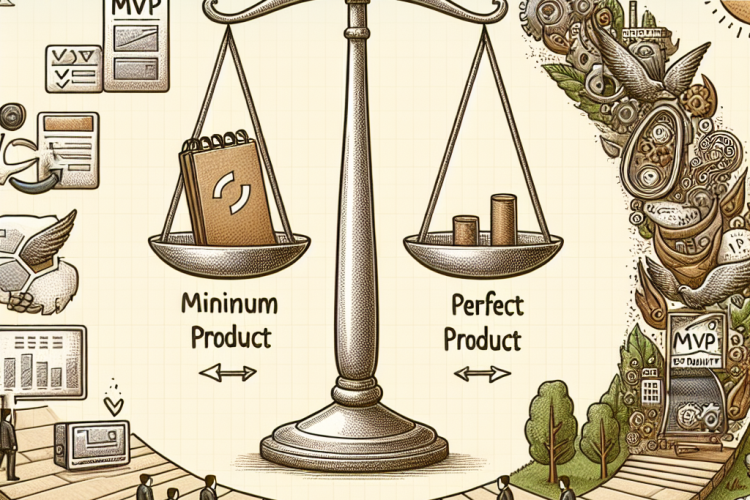
In the rapidly evolving world of business and technology, the idea of bringing a product to market quickly has become more significant than ever. This necessity raises an important debate: should you launch a Minimum Viable Product (MVP) or aim for a Perfect Product? This article explores the two concepts, their benefits and drawbacks, and how to find the right balance for your business.
Understanding the Concepts
To effectively navigate the MVP vs. Perfect Product debate, it’s essential to define both terms clearly.
Minimum Viable Product (MVP)
An MVP is a version of a new product that includes only the essential features necessary to satisfy early adopters. The primary goal of an MVP is to get feedback from users as quickly as possible, allowing businesses to refine their product based on real user interaction.
- Speed to Market: An MVP allows companies to launch faster and start collecting feedback.
- Resource Efficiency: It requires fewer resources, minimizing initial investment compared to a fully developed product.
- User-Centric Development: Engaging with users early leads to products that better meet market needs.
Perfect Product
A Perfect Product, on the other hand, is fully developed, polished, and packed with all desired features and functionalities. This approach often involves extensive research, development, and testing before launching.
- Quality Assurance: A Perfect Product is usually free of bugs and has gone through rigorous testing.
- Brand Image: Launching a refined product can enhance the company’s reputation and perceived value.
- Comprehensive Features: It includes all features that a target audience might find valuable.
Pros and Cons of MVP
MVPs have gained popularity among startups and established companies alike. However, they come with their own set of advantages and disadvantages.
Pros of MVP
- Faster Validation: Companies can validate their ideas in the market quickly.
- Cost-Effective: MVPs help in testing market conditions with reduced financial risk.
- Real-Time User Feedback: Early adopters provide valuable feedback, enabling better product iterations.
Cons of MVP
- Perceived Quality: A poorly executed MVP can damage a brand’s reputation.
- Limited Features: Users might be disappointed due to missing functionalities.
- Scope Creep: Feedback might lead to overcomplicating the product instead of refining it.
Pros and Cons of Perfect Product
While creating a Perfect Product appears to be the gold standard, it’s not without its limitations.
Pros of Perfect Product
- Enhanced User Experience: A polished product will likely offer a superior experience.
- Lower Support Costs: Fewer bugs mean less customer trouble-shooting and related costs.
- Stronger Initial Impact: A well-designed product can create a stronger initial market impact.
Cons of Perfect Product
- Time to Market: Extensive development may delay the launch.
- High Costs: The investment required can strain resources, especially for startups.
- Market Changes: Trends can shift during the development phase, making the product less relevant upon launch.
Finding the Balance
With the pros and cons of both MVP and Perfect Product approaches in mind, the key to success lies in finding the right balance for your business. Here are several strategies you can employ:
1. Define Your Objectives
Understanding your primary goals is crucial. Are you looking to enter a competitive market quickly, or do you prioritize quality and reputation? Your objectives will guide your product development strategy.
2. Conduct Market Research
Engaging with potential users during the research phase can provide insights into what features are most desired. This can help shape your product into a suitable MVP or a more feature-complete offering based on verified user needs.
3. Arrange Iterative Development
Instead of launching a finalized product or an MVP, consider an iterative approach. Start with an MVP, gather feedback, and gradually introduce features based on user input. This can help in balancing speed and quality effectively.
4. Apply Lean Startup Principles
The Lean Startup methodology advocates for rapid prototyping and iterative product releases based on validated learning. This allows companies to create a product that adapts and evolves based on real user experiences.
5. Monitor Market Trends
If you opt for an MVP, remain alert to market trends and customer feedback. This vigilance can inform subsequent iterations of the product, allowing it to evolve in line with user expectations.
Case Studies: MVP Success and Failure
To better understand the nuances between MVP and Perfect Product approaches, let’s examine some real-world case studies.
Successful MVP Example: Dropbox
Dropbox is a prime example of a successful MVP launch. Before developing the actual product, Dropbox created a simple video explaining the concept of cloud storage and file sharing. This MVP helped gauge user interest and led to substantial funding for development. The success of Dropbox lies in its rapid iteration based on user feedback.
Failed Perfect Product Example: Google Wave
Google Wave was a perfect product that failed to gain traction. Despite being a fully developed product, it was complex and confusing for users, who did not understand its value. Google invested heavily in this product but failed to iterate quickly based on user feedback, leading to its eventual discontinuation.
Conclusion
The debate between MVP and Perfect Product is crucial for businesses navigating the complexities of product development. While MVPs allow for quick validation and feedback, focusing too much on speed may compromise quality and user experience. Conversely, aiming for a Perfect Product can lead to unnecessary delays and potentially missing market opportunities.
Ultimately, the right balance depends on your business’s unique goals, market conditions, and audience needs. By adopting a flexible approach—one that integrates iterative development and user feedback—you can create a product that resonates with users, enhances satisfaction, and drives business success.



0 Comments