
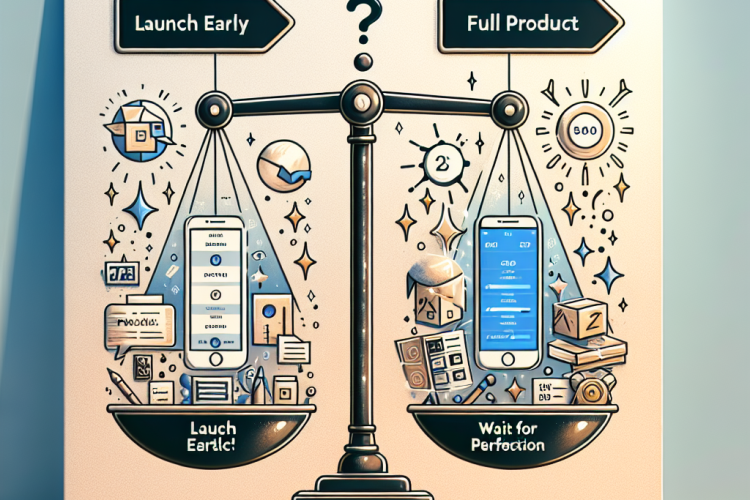
The landscape of product development is riddled with strategic decisions, especially when it comes to the timing and nature of a product’s launch. Entrepreneurs and product managers often grapple with the fundamental dilemma: should they launch a Minimum Viable Product (MVP) or a Full Product? Understanding the nuances of MVPs and full products, the advantages and disadvantages of each approach, and the contexts that favor one over the other is crucial for achieving success in today’s competitive market.
Understanding the Minimum Viable Product (MVP)
A Minimum Viable Product (MVP) is a version of a new product that includes only the essential features necessary to satisfy early adopters. The goal is to gather feedback from users with minimal investment and time. Here are some key aspects of MVPs:
- Core Features Only: MVPs contain the simplest form of the product, usually focusing on the core functionalities that solve the primary problem for users.
- User Feedback Loop: The main reason for launching an MVP is to test assumptions and receive feedback from real users to inform future development.
- Faster Time to Market: By stripping down features, you can launch faster and start the learning process sooner.
- Cost Efficiency: An MVP requires less investment than a full product, making it a safer bet for startups and new ventures.
Advantages of Using an MVP
Launching an MVP offers various advantages, especially for startups and new products:
- Reduced Risk: By validating ideas before a full launch, startups can mitigate the financial risks associated with failure.
- Market Validation: An MVP helps ascertain whether there’s a real market need for the proposed solution, guiding future enhancements.
- Focus on User Needs: Gathering user feedback helps teams make informed decisions that align with actual user requirements rather than assumptions.
- Iterative Development: The MVP approach fosters a culture of iterative development, allowing for continuous improvements based on user input.
Challenges of MVPs
Despite the advantages, MVPs do come with challenges:
- Risk of Poor First Impressions: A poorly executed MVP can lead to negative perceptions, deterring potential future users.
- Limited Features May Frustrate Users: If an MVP lacks key functionalities, it might drive users away instead of attracting them.
- Misinterpretation of Feedback: Startups may misread feedback, leading to decision-making based on biased user input.
- Short-Term Focus: An overemphasis on immediate feedback may impede long-term vision and roadmap planning.
When to Launch an MVP
Several factors signal the readiness for an MVP launch:
- Early Stage of Development: MVPs are typically best suited for the initial phases of product development when concepts are still being validated.
- Available Resources: Teams with limited resources may favor MVPs to minimize costs while exploring new ideas.
- Market Uncertainty: In unpredictable markets, validating concepts through MVPs can mitigate risks before a larger commitment.
Understanding the Full Product
An alternative to the MVP is the Full Product, which is a fully developed version intended for a broader market launch. It contains all the planned features and functionalities, often embodying the complete vision of the product.
Advantages of Full Product Launch
Launching a full product also has its merits:
- Comprehensive User Experience: A full product delivers a complete experience, meeting user expectations from the outset.
- Established Brand Image: A well-executed full product can establish a strong brand presence and reputation.
- Competitive Differentiation: Full products often offer a higher degree of differentiation against competitors by showcasing a broader range of features.
- Customer Trust: A polished product can foster trust among users, which is vital for long-term customer relationships.
Challenges of Full Product Launches
However, there are also some drawbacks to launching a Full Product:
- Higher Cost and Time: Developing a full product requires more resources, both financially and in terms of time, which can strain budgets and timelines.
- Risk of Misalignment with Market Needs: Investing heavily in a full product without validating needs beforehand can lead to catastrophic failures.
- Delayed Feedback: Full product launches may delay the feedback loop, making it harder to make informed, iterative changes based on user input.
- Expectation Management: Users may have higher expectations for a fully developed product, and failing to meet these can have significant repercussions.
When to Launch a Full Product
Full product launches are most suitable in specific situations:
- Market Saturation: If the market is crowded and competitors are offering full solutions, launching a comprehensive product may be necessary to capture market share.
- Strong Value Proposition: A product that presents a clear value proposition and solves a significant problem may warrant a full product launch.
- Sufficient Funding: Projects that have adequate backing can afford the time and resource investment for a full product.
- Established Brand Presence: Companies with existing customers may find it beneficial to leverage their reputation through a full product.
MVP vs. Full Product: A Comparative Analysis
To illustrate the differences further, let’s compare MVPs and Full Products across several dimensions:
1. Development Time
MVPs require significantly less development time compared to full products. By focusing on core functionalities, teams can rapidly iterate and launch faster.
2. Cost
The cost associated with MVPs is generally lower, as they require fewer resources. Full products demand a greater investment upfront.
3. Risk Level
While MVPs allow for testing and validation, full products carry a higher risk, particularly if the product does not resonate with users.
4. Time to Feedback
MVPs provide quicker access to user feedback, facilitating a more responsive development process, whereas full products may take longer to gather insights.
5. User Expectations
Users generally approach MVPs with an understanding of their experimental nature, while expectations for full products tend to be significantly higher, demanding robust performance and features.
Conclusion
The decision between launching an MVP or a Full Product is nuanced and must be carefully considered based on various factors, including market conditions, resource availability, and the specific goals of a company. MVPs serve as a strategic tool for learning and adaptation, particularly in uncertain environments. On the other hand, Full Products offer the opportunity to make a significant impact and build a stronger brand presence, albeit with greater risk and investment.
Ultimately, the journey from idea to launch is not a one-size-fits-all process. Product managers must weigh the pros and cons of both strategies and make informed choices that align with their vision, resources, and market dynamics. Understanding when to launch and why it matters can significantly influence the trajectory of a product’s success.



0 Comments