
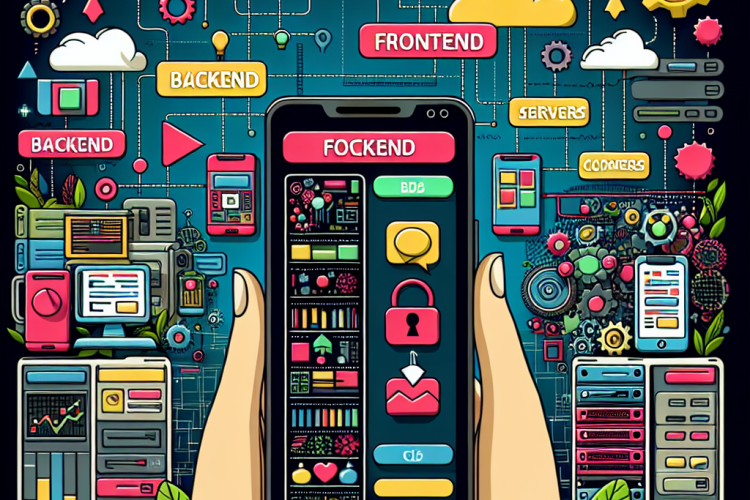
In the realm of app development, two fundamental areas dominate the process: frontend and backend development. These components are essential for creating applications that are not only functional but also provide a seamless user experience. Understanding the distinctions between frontend and backend development is crucial for anyone involved in app development, whether you’re a developer, project manager, or business stakeholder.
Definitions and Roles
Frontend Development refers to the client-side part of app development. This is what users interact with directly in a web application. It includes everything that users experience directly: from the visuals and layout to interactive elements. The primary languages used in frontend development are HTML, CSS, and JavaScript.
Backend Development, on the other hand, involves the server-side of the application. It is responsible for managing the database through queries and APIs, user authentication, server, application, and server logic. It handles data manipulation and works as the backbone of any application, ensuring that the frontend has the data and functionality it needs.
Key Differences
1. Language and Frameworks
Frontend and backend development use different sets of programming languages and frameworks, each optimally designed for the respective tasks they handle.
Frontend Languages: The core tools for frontend developers are HTML, CSS, and JavaScript. Frameworks like React, Angular, and Vue.js enhance JavaScript functionalities and aid in creating dynamic interfaces.
Backend Languages: Backend development can be executed through languages like Java, Python, Ruby, PHP, and Node.js. Frameworks such as Django, Express.js, Ruby on Rails, and Laravel assist in building robust applications.
2. Development Focus
The focus of frontend development is mainly on the aesthetics and usability of an application.
In Frontend Development, emphasis is placed on creating a cohesive and visually appealing interface. Developers must ensure that the application runs smoothly across different devices and screen sizes.
For Backend Development, the focus is on database management, app performance, and maintaining the architecture of the app.
3. User Interaction
Frontend development deals directly with users, requiring skills in UI/UX design to create interfaces that engage users and are easy to navigate.
Backend development, meanwhile, does not interact with users but supports frontend systems to enable user interaction with the application.
Frontend Technologies
HTML (Hypertext Markup Language): A standard markup language used to create the structure of web pages.
CSS (Cascading Style Sheets): Used for describing the presentation of a document written in HTML or XML.
JavaScript: A programming language that enables interactive web pages; it is an essential part of web applications.
React, Angular, Vue.js: Popular frontend frameworks that provide developers with tools to create modular and efficient user interfaces.
Backend Technologies
Node.js: An open-source, cross-platform JavaScript runtime environment that executes JavaScript code outside of a browser.
Python: Known for its readability and simplicity, often used with frameworks like Django and Flask for backend development.
Ruby on Rails: A server-side web application framework written in Ruby, emphasizing convention over configuration.
PHP: Widely used for web development and can be embedded into HTML.
Integration and Collaboration
A successful app development process requires seamless integration between the frontend and backend. Communication between these layers happens through APIs (Application Programming Interfaces), which enable data exchange.
Collaboration between frontend and backend developers is crucial. These teams must work closely to ensure that the application’s business logic and user interface are in harmony.
Security Considerations
Security is critical in both frontend and backend development. While the backend handles sensitive data storage and transactions, frontend security measures are necessary to protect users from vulnerabilities like cross-site scripting (XSS) and cross-site request forgery (CSRF).
Performance and Scaling
Backend scalability is crucial for handling increased loads and maintaining performance. Technologies like cloud computing and distributed databases play a pivotal role in achieving scalability.
Frontend performance often deals with optimizing assets, ensuring fast loading times, and minimizing user wait time through efficient code and resources management.
Tools and Development Environment
Frontend developers rely on tools like code editors, version control systems, and package managers (e.g., npm). Performance testing tools and browser developer tools are essential for testing and debugging.
Backend developers use IDEs, server management tools, and frameworks that support the languages they work with. Database management systems and containerization tools like Docker are crucial for backend development.
Trends and Future Directions
Both frontend and backend development fields are rapidly evolving. Frontend development sees continuous advancement with progressive web apps and the increasing adoption of frameworks that align with mobile-first approaches.
In backend development, the focus is on microservices architecture, serverless computing, and enhancing the security and scalability of applications to cater to growing user bases.
In summary, frontend and backend development are two sides of the same coin, each vital to app success. Frontend developers focus on ensuring users have a seamless and visually appealing experience, whereas backend developers handle the logic, database interactions, and overall application performance.
The synergy between backend and frontend components is essential for delivering efficient, user-friendly applications. Understanding these roles helps businesses make informed decisions in resource allocation, team building, and project management, ensuring that both the user interface and underlying systems align with business goals and user needs.



0 Comments