
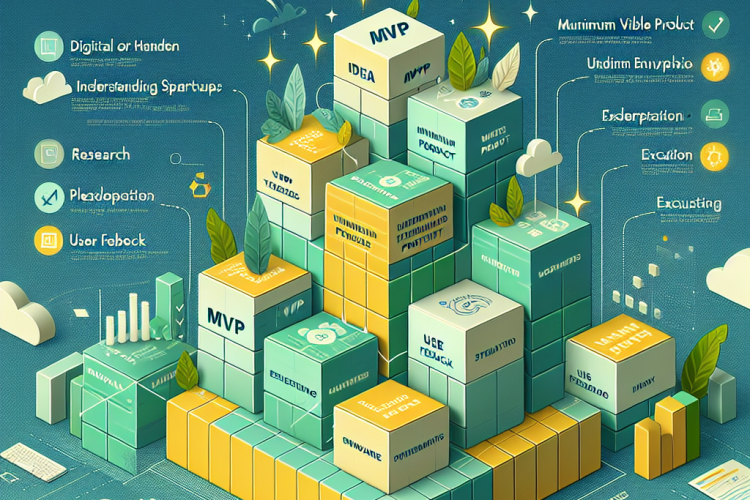
The journey of a startup is often daunting and filled with uncertainties. One of the most critical elements that can influence the success of a startup is its ability to efficiently develop and market its product. At the heart of this process is the concept of a Minimum Viable Product (MVP). An MVP serves as a crucial tool for startups, providing a pathway to gather user feedback, validate business ideas, and mitigate risks. This article explores the significance of MVPs in the startup ecosystem, outlines their essential components, and emphasizes their role as building blocks of success.
What is a Minimum Viable Product (MVP)?
A Minimum Viable Product (MVP) is a version of a new product that includes only the features necessary to satisfy early adopters. The primary aim of launching an MVP is to gather valuable feedback from real users to inform further development. By focusing on the core functionalities, startups can conserve resources, avoid unnecessary development, and validate their business model with minimum investment.
The Value of an MVP
The MVP approach allows startups to enter the market faster and with less risk. Instead of investing significant time and resources into developing a full-fledged product, they can test their hypotheses with a simplified version. The feedback obtained from early adopters helps in refining product features, addressing issues, and ensuring that the final product meets market demands.
The Components of an MVP
To create an effective MVP, startups need to focus on several key components:
1. Core Problem Identification
Before developing an MVP, it is essential to identify the core problem the product aims to solve. This involves understanding the needs and pain points of the target audience. Startups should engage in market research to validate their assumptions and ensure that their proposed solution provides real value.
2. Defining Key Features
Once the core problem is identified, the next step is to outline the crucial features that will address this problem. Startups should prioritize functionalities that are essential for solving the users’ issues, avoiding the temptation to add non-essential features that may divert focus from the main objectives.
3. User Experience (UX) Design
An MVP should offer a good user experience even with limited features. Developers should pay attention to the design and usability of the product. A pleasant and intuitive interface can lead to better user engagement and feedback. The goal is to make sure that the users can easily understand and navigate the core functionalities.
4. Feedback Mechanisms
Integrating feedback mechanisms is crucial in an MVP. Startups should implement tools to collect user input, such as surveys, interviews, or analytics. This feedback is invaluable in identifying strengths and weaknesses and can guide future product iterations.
5. Iterative Development
The process of creating an MVP is not linear but iterative. After launching the MVP and gathering user feedback, startups should be prepared to make adjustments. This may involve tweaking existing features, adding new functionalities, or even re-evaluating the core problem being addressed. The key is to remain agile and responsive to user needs.
Implementing an MVP Strategy
Implementing an MVP strategy involves a systematic approach. Here are the steps a startup should consider:
1. Market Research
Conduct thorough market research to understand the competitive landscape. Identify competitors and analyze their products’ strengths and weaknesses. This can help in positioning the MVP effectively and defining its unique selling proposition (USP).
2. Customer Personas
Create customer personas to better understand the target audience. Knowing the demographics, behaviors, and preferences of potential users can help tailor the MVP to their specific needs.
3. Prototyping
Before building the MVP, consider developing prototypes or wireframes. This can facilitate discussions about features and design among stakeholders and can also help in visualizing the product before actual development.
4. Development and Launch
With a clear plan and design in place, development can begin. Once the MVP is ready, it should be launched to a selected group of users—often referred to as early adopters—who are more likely to provide constructive feedback.
5. Analyze and Iterate
After the launch, analyze the feedback gathered through surveys, user interactions, and data analytics. Use this information to prioritize changes and next steps in the development cycle. This iterative process is crucial for refining the product and enhancing its market fit.
Challenges and Pitfalls in MVP Development
While the MVP approach offers numerous advantages, startups may face several challenges during the development process:
1. Overcomplicating Features
One common pitfall is overcomplicating the MVP with too many features. This counteracts the purpose of an MVP, which is to focus on the core functionalities. Startups should resist the urge to add “just one more thing.”
2. Ignoring User Feedback
Launching the MVP is just the beginning. Ignoring feedback from early users can lead to a disconnect between the product and market needs. Continuous engagement with users and responsiveness to their feedback is essential for success.
3. Underestimating Marketing
A well-developed MVP will not succeed without effective marketing. Startups need to create awareness and generate interest in their product. Failing to do so may result in low user engagement and feedback, undermining the entire MVP strategy.
4. Lack of Clear Objectives
Without clearly defined objectives, it can be challenging to measure the success of the MVP. Startups should set specific goals related to user engagement, feedback quality, and feature validation before the launch.
Examples of Successful MVPs
Several successful companies have leveraged the MVP approach in their early stages:
1. Dropbox
Dropbox initially launched with a simple video demonstrating its technology rather than a fully functioning product. This helped gauge interest and gather sign-ups before investing in development.
2. Airbnb
Airbnb started with a basic website that allowed users to rent out air mattresses in their apartments. This simple MVP enabled the founders to test their idea and gather valuable feedback, which ultimately led to the platform’s massive growth.
3. Spotify
Spotify launched an MVP with only the essential features to test user interest in streaming music. Feedback from users played a crucial role in developing new features and optimizing the platform.
Conclusion
The MVP serves as a critical strategy for startups, enabling them to validate their business ideas while minimizing risk and resource expenditure. By focusing on core functionalities, engaging with early adopters, and remaining responsive to feedback, startups can refine their products and enhance their chances of success in a competitive market. However, the journey does come with challenges, and founders must remain vigilant against common pitfalls. In a dynamic marketplace, the ability to iterate and adapt based on user insights is paramount. Ultimately, the MVP approach not only proves the viability of an idea but sets the foundation for sustainable growth and innovation.



0 Comments